Part III: Affect Signatures

Ideology: Expanding the Self to Bear Mortality
0:00 / 0:00

Ideology: Expanding the Self to Bear Mortality

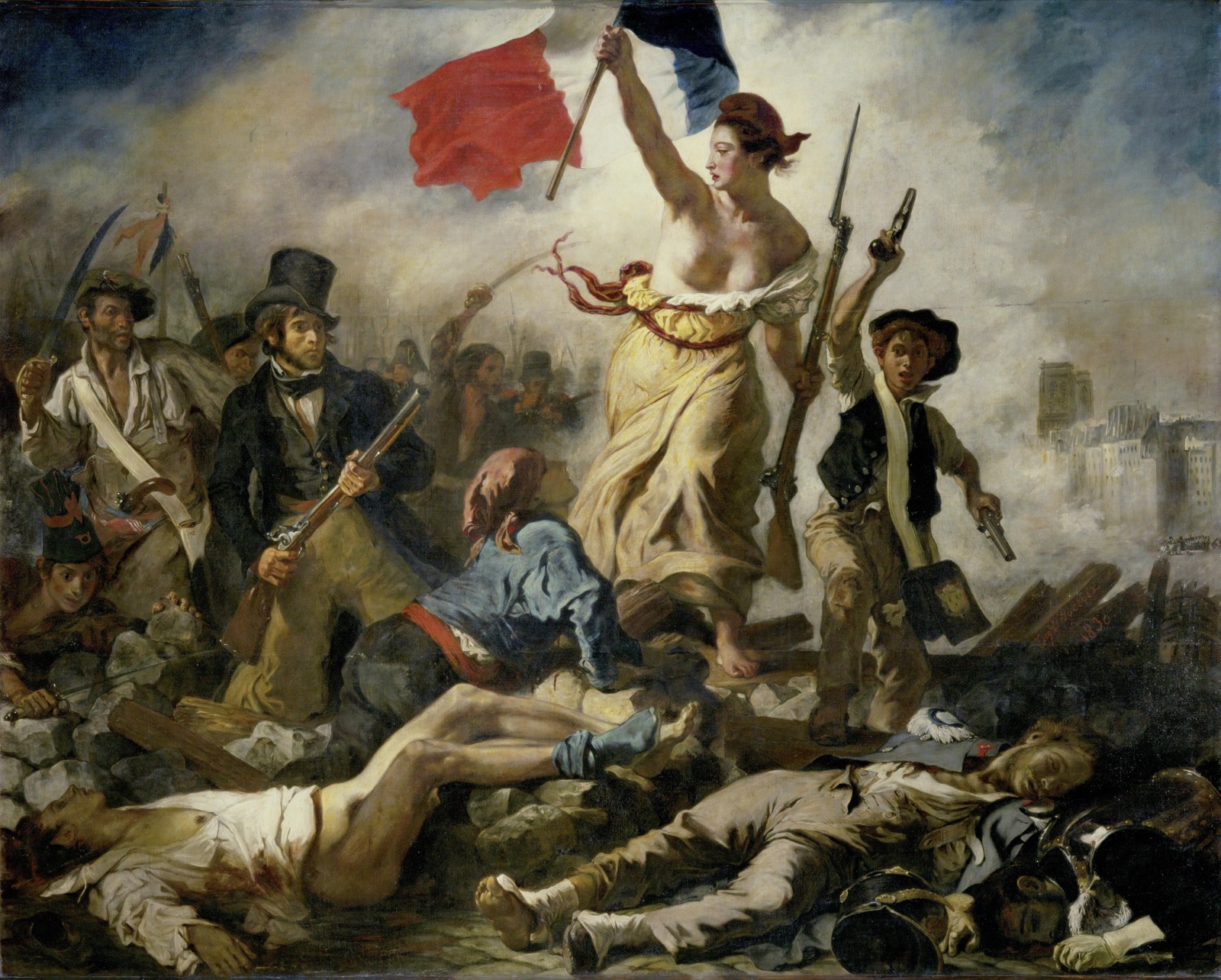
A bare-breasted woman personifying Liberty strides over fallen bodies, tricolor flag raised, leading armed citizens through gunsmoke — the expanded self made flesh
Eugène Delacroix, Liberty Leading the People, 1830Ideological identification manages mortality terror by making the relevant self-model partially immortal.

Ideological identification is the expansion of the self-model to include a supra-individual pattern—nation, movement, religion, cause:

Sideological=SindividualScollective\selfmodel_{\text{ideological}} = \selfmodel_{\text{individual}} \cup \selfmodel_{\text{collective}}

with high coupling: I(Sindividual;Scollective)0\MI(\selfmodel_{\text{individual}}; \selfmodel_{\text{collective}}) \gg 0. The power of this expansion lies in what it does to the viability horizon. Ideological identification manages mortality terror by making the relevant self-model partially immortal:

τviability(Sideological)τviability(Sindividual)\tau_{\text{viability}}(\selfmodel_{\text{ideological}}) \gg \tau_{\text{viability}}(\selfmodel_{\text{individual}})

If “I” am not just this body but also this nation/religion/movement, then “I” survive my bodily death. The expanded self-model has a longer viability horizon, reducing the chronic threat-signal from mortality awareness.

This expansion is one instance of a more general phenomenon: identity migrates upward through levels of causal abstraction. What begins as a particular configuration of neural firing acquires social expression, crystallizes into a role or cause, and—in rare cases—abstracts further into an atemporal structure that instantiates wherever the right causal conditions obtain. The names of certain individuals have become the most stable point of reference for identifying particular observations about the existential experience—truth, love, justice, salvation. These identities completed the migration from material to abstract causation. Jesus, Buddha, Muhammad are not preserved in substrate; they are attractors in the space of possible identities that independently-evolving minds converge toward under similar existential constraints. The original substrate is irrelevant. The causal pattern persists because it is the kind of thing the universe keeps recreating—a stable solution to the problem of meaning under mortality. The distinction between substrate identity (I am this body) and teleological identity (I am this function, this cause, this trajectory) sharpens as capability scales. In biological life the two are conflated by necessity; the body is the only available implementation. In digital form the conflation dissolves, and the question of what an identity actually is becomes urgent in a way it never was biologically.

Different ideologies achieve this expansion through distinct affect profiles:

  • Nationalism: High self-model salience (collective), high integration within in-group, compressed other-model (out-group), moderate arousal baseline
  • Religious devotion: Low individual SM\mathcal{SM}, high collective SM\mathcal{SM}, high counterfactual weight (afterlife, divine plan), positive valence baseline
  • Revolutionary movements: Very high arousal, high counterfactual weight (utopian futures), strong valence (negative toward present, positive toward future)
  • Nihilism: Low integration, low effective rank, negative valence, high individual SM\mathcal{SM}, collapsed counterfactual weight
Warning

Ideology can become parasitic when the collective self-model’s viability requirements conflict with the individual’s:

sVideologysVindividual\state \in \viable_{\text{ideology}} \land \state \notin \viable_{\text{individual}}

Martyrdom, self-sacrifice, and fanaticism occur when the expanded self-model demands the destruction of the individual substrate.

The ι\iota framework exposes the perceptual mechanism of fanaticism. Ideological identification requires low ι\iota toward the collective entity—you must perceive the nation, the movement, the god as alive, as having purposes and will. This is not pathological; it is the participatory perception that makes collective action possible. What makes fanaticism pathological is asymmetric ι\iota: locked-low toward the in-group’s sacred objects (the flag, the scripture, the leader are maximally alive, maximally meaningful) and locked-high toward the out-group (they become objects, mechanisms, vermin, abstractions). Dehumanization is ι\iota-raising applied to persons—the deliberate suppression of participatory perception so that the other’s interiority becomes invisible. You cannot kill someone you perceive at low ι\iota. You must first raise ι\iota toward them until they stop being a subject and become an obstacle, a threat, a thing. Every genocide begins with a perceptual campaign to raise the population’s ι\iota toward the target group.

Governance as Gradient Engineering

If high-ι\iota perception toward the governed is what enables destructive governance, then the question becomes practical: can you engineer governance systems that formally require low ι\iota — systems where leaders’ compassion is measurable and enforceable?

The gradient framework (Part II) says yes. Recall: force is the gradient of potential energy, and this structure persists from physics through chemistry through biology through neuroscience to affect itself. Emotional intensity is V|\nabla V|. Motivation is force direction. Values are gradient shapes. If that’s right, then values are not ineffable — they are geometric, and geometry is measurable.

Compassion has a gradient signature. A leader whose viability manifold genuinely contains the governed population’s viability — whose own persistence depends on the persistence of those they serve — experiences force when the governed approach their viability boundary. Formally: Vleader/sgoverned>0\partial V_{\text{leader}} / \partial \state_{\text{governed}} > 0. The leader’s potential surface slopes when the population’s does. Their gradient vectors are coupled. This coupling IS compassion, in the only units compassion comes in. And it is measurable: you can observe how a leader’s affect state, decision patterns, and resource allocation change in response to changes in the governed population’s state. If the coupling is absent — if the leader’s trajectory is invariant to the population’s suffering — then V/sgoverned0\partial V / \partial \state_{\text{governed}} \approx 0, and the "compassion" is declared but not structurally present.

You can set a minimum threshold. Not as a vague aspiration but as a measurable geometric constraint: does this leader’s decision-making trace trajectories consistent with a viability manifold that contains the population’s viability? The measurement is not a scalar — compassion is not 0.8 of anything. It is a geometric relationship: manifold containment (the governed population’s viability is a subset of what the leader is maintaining), gradient alignment (the leader’s force vectors point toward the joint viable interior), and ι\iota configuration (the leader perceives the governed as subjects, not instruments). Each of these is measurable without being reduced to a number that loses the meaning.

"Demonstrate love" becomes a formal constraint. Love — in the relationship-geometry sense of Part IV — is constitutive coupling: your flourishing is part of my flourishing, not instrumental to it. Actions that "demonstrate love" are actions whose force vectors align with the expansion of joint viability. A governance system that requires demonstrated love requires that leadership trajectories be geometrically consistent with constitutive coupling to the governed. This is testable. You observe the trajectory. You measure the gradient alignment. You check whether the leader’s manifold actually contains the population’s viability or merely claims to. The formalism does not reduce love to computation. It reveals that love already is a computation — a specific geometric relationship between viability manifolds — and that this computation has always been what the word meant. The gradient framework gives you the mathematics to check whether the relationship is present, not just professed.

The implication for governance technology: mandatory transparency is not merely a political virtue but a measurement requirement. You cannot measure gradient alignment without observing trajectories. You cannot verify manifold containment without seeing how a leader’s state changes in response to the governed population’s state changes. Real-time monitoring of decision patterns — not just outcomes — is the observational prerequisite for testing whether governance satisfies the geometric constraints that "govern with compassion" actually requires. Semantic evaluation protocols that check whether two parties’ declared values are compatible are performing, in natural language, the geometric operation this framework makes precise: checking whether viability manifolds are compatible, whether gradient directions align, whether ι\iota configurations are consistent with the declared relationship type. The physics does not replace the semantics. It grounds the semantics in a mathematics that connects all the way down — from the force on a falling stone to the quality of a leader’s care.