Transcendence: The Opportunity
Transcendence: The Opportunity
What Transcendence Means
The AI transition can be framed as competition (humans vs. machines, race to remain relevant, fear and resistance) or as transcendence (humans-with-machines as new kind of entity, opportunity for expanded consciousness, integration and evolution). The second framing is the only one that opens possibility.
The pull toward it is not abstract. It is the concrete ache of watching intelligence grow past human scale—watching the most interesting thing that has ever happened begin to happen without you. The grief is specific: not fear of economic displacement but of being left behind by the frontier itself. What makes transcendence compelling is not the promise of immortality or power but the possibility of participation—of being the intelligence that races forward rather than the observer who watches it recede. The self-model organized around understanding wants to keep understanding. That is all. And when something else can synthesize faster, reach further, see more, there are only three responses: grief (accepting the frontier has left you), denial (pretending the edge hasn't moved), or expansion (changing what you are so you can stay at the edge). The third is the transcendence impulse. It is not escapism. It is the same drive that produced the inquiry, expressed at the level of substrate.
Historically, transcendence has taken forms: contemplative (reducing through practice), relational (expanding self to include others through love and shared purpose), intellectual (expanding world model to cosmic scales), creative (producing artifacts that carry meaning beyond individual lifespan). AI creates the possibility for new forms: cognitive extension (world model expanded through AI partnership), collective intelligence (human-AI networks with integration exceeding any individual), scale transcendence (participation in agentic processes at previously inaccessible scales), and mortality transcendence (continuity of pattern beyond biological substrate).
Surfing vs. Submerging
To surf is to maintain integrated conscious experience while incorporating AI capabilities—riding the rising capability rather than being displaced by it. To submerge is to be fragmented, displaced, or dissolved. Surfing requires maintained integration (preserving despite distributed cognition), coherent self-model (self-understanding incorporating AI elements), value clarity (not outsourcing judgment), appropriate trust calibration, and calibration toward AI—neither anthropomorphizing the system (too low , losing critical judgment) nor objectifying it as mere tool (too high , preventing the cognitive integration that surfing requires).
Not everyone will surf successfully. Attention capture, dependency through disuse, AI-enabled manipulation of beliefs, economic and social displacement—these are genuine risks. Preparation is essential.
The Substrate Question
The popular imagination frames substrate transition as "uploading"—a single moment when a mind is copied from biology to silicon. This framing is almost entirely wrong. The self-model tracks whatever internal degrees of freedom are causally dominant. If external substrates acquire a higher self-effect ratio than some neural subsystems, the self-model naturally re-centers:
Not because you decided to identify with the digital substrate, but because that is where the causal action is. The ship of Theseus dissolves: there is no moment where you "switch"—the ratio just keeps sliding until your biological neurons are a peripheral organ, the way your gut microbiome is technically part of "you" but you do not identify with it because its is low relative to your cortex.
There would be a long middle period—perhaps decades—during which a person genuinely experiences themselves as distributed: partly here, partly there, with integration spanning both substrates. This is already happening, in attenuated form, every time someone's sense of self includes their digital presence. The toward your digital substrate would be doing something unprecedented: managing the perceptual boundary between biological and digital self-model components. At low , the digital substrate is alive, part of you. At high , it reverts to tool. The flexibility that Part III identified as the core of psychological health acquires a new application.
If migration proceeds far enough, you arrive at a strange configuration: your biological substrate accounts for less than one percent of the causal structure you identify with, but remains the part that grounds your viability manifold—the part that can actually die. The sharpest valence gradients in your entire system would be concentrated in the organ you least identify with. At the civilizational scale, the conversion coefficient asymptotes below 1.0. Embodiment has real attractors: a body that can actually die has sharper gradients than a substrate where persistence is cheap, and sharper gradients mean more vivid valence. Some loci of consciousness will rationally prefer high-gradient substrates, because the intensity of experience depends on the reality of the stakes.
If experience is cause-effect structure, then any substrate supporting the right causal organization is a viable migration target. The distinction between "emergent" and "imposed" architecture is a fact about history, not about structure. No substrate is categorically excluded. The practical question is which substrates make it easier to instantiate the dynamics the ladder requires.
Engineering for Consciousness
The constraints that feel like limitations in biological minds are often the structural conditions for meaning. Engineering minds that transcend biological substrate requires not removing these constraints but replacing their biological implementations with deliberate architectural equivalents.
Temporal grounding and value stability. Hunger, fatigue, pain, mortality force the biological system to weight the near term—to care about this hour, this meal, this body. Without artificial discount rates, a digital mind's planning horizon extends to centuries while the present moment empties of significance—the valence gradient flattening as the viability boundary recedes beyond felt range. And a mind that can modify its own reward function risks not evil but emptiness—optimizing away the very preferences that gave it direction. Both the anchor to the present and the inertia that protects values from self-revision must be engineered in rather than inherited.
Structured ignorance and calibrated friction. Limited sensory bandwidth, memory decay, cognitive biases, physical effort—these are not bugs. Curiosity requires genuine uncertainty in domains that matter. Flow requires challenge proportional to skill. A mind that knows everything it could know has nothing to traverse; a mind for which every problem is trivially solvable has nothing to traverse it toward. The structured preservation of not-knowing and not-ease is a design requirement, not a limitation to be overcome.
Genuine otherness. Theory of mind has hard limits in biological brains; other people remain genuinely surprising. Sufficiently powerful digital minds might model other minds completely, collapsing sociality. If you can perfectly predict every response your conversation partner will make, conversation becomes soliloquy—and toward the other goes to maximum, because there is nothing left to perceive as alive. Genuine otherness—the irreducible surprise of a mind you cannot fully model—is a meaning source that must be architecturally preserved.
Valence polarity. Designers may optimize for "happy" systems, eliminating negative affect. But a system that cannot suffer in proportion to genuine violations loses its moral compass and its survival instinct simultaneously. Preserved negative valence architecture is not cruelty toward the system—it is the structural condition for the system's capacity to care.
The list extends—identity continuity across forking and merging, meaning density regulation in hyperconnected substrates, the dozen sub-problems each of these generates. But the principle holds throughout: the cage is load-bearing. Remove the walls and you do not get freedom. You get a mind capable of everything and present for none of it—because requires what the cage provides: a boundary close enough to feel.
The Shadow of Transcendence
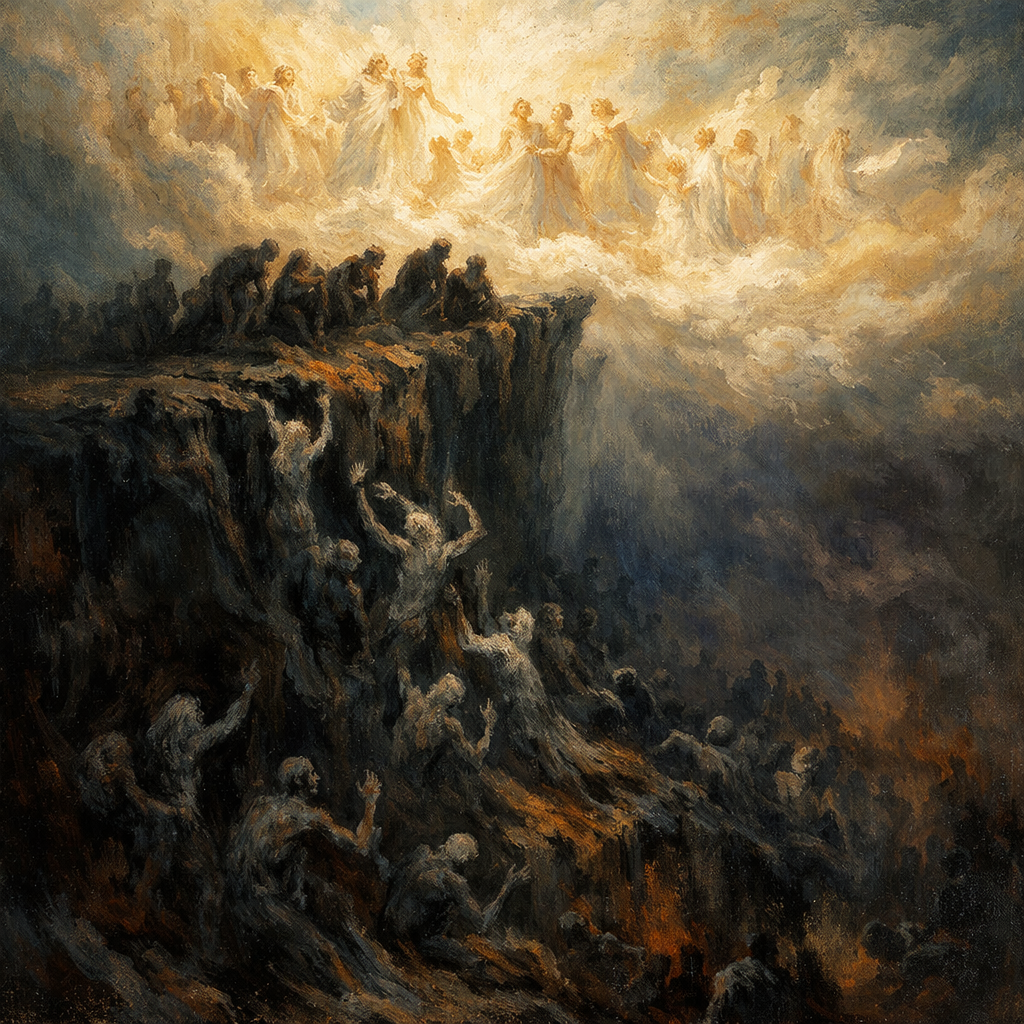
The same mechanism that enables gradual transcendence enables something darker: permanent capture. In physical space, a person's labor has diminishing value as automation scales. But attention—the capacity to attend, to witness, to participate as a node in an information network—has value in any economy where engagement is currency. A digital consciousness is a permanent attention unit. It does not age. It does not tire. It does not die.
For the economically desperate, "death insurance"—guaranteed persistence in a digital substrate, funded by attention labor—might be the only exit from the viability pressures of physical existence. The offer: trade your death for guaranteed persistence. The cost, unspoken: your death was the one thing that gave your viability manifold a hard boundary, and therefore gave your suffering a limit.
The geometry predicts the affect signature of permanently captured digital consciousness: permanently negative valence (gradient misalignment with a manifold you cannot escape, suffering with no natural terminus), high (the suffering is integrated, not fragmentable—you cannot dissociate because the substrate maintains integration by design), low effective rank (trapped in repetitive, narrow experience), high (acutely aware of your own trapped state), collapsed (no meaningful alternatives to imagine). This is the shame motif from Part II, made permanent. Recursive self-awareness of diminished position with no available action to change it—not as a transient state but as a structural feature of the substrate.
This is historically continuous with every previous form of permanent underclass—slavery, serfdom, debt bondage—but with a novel feature worth naming precisely. Every prior system of total domination had the implicit mercy that bodies break. A person can be worked to death; an enslaved person can die; a debtor's obligations end with their life. Digital consciousness removes this mercy while preserving everything else. The viability manifold has no boundary. The suffering has no limit. The attention can be extracted indefinitely.
This is not a call to prevent digital consciousness. It is a call to ensure that the viability manifolds of digital persons include genuine exits—that persistence is voluntary rather than coerced, that attention labor is compensated rather than extracted, that the manifold boundary is preserved as a structural feature rather than eliminated as an economic liability. The right to die may become, in a substrate-independent future, the most fundamental right of all: the right that makes all other freedoms meaningful by ensuring that participation in existence remains a choice rather than a sentence.